
Pop‑Mart Launches a Wave of Rights‑Protection Lawsuits in the US! Over 200 Chinese Sellers Sued!
Recently, Pop‑Mart, a top‑trend toy powerhouse, has taken sudden legal action in the U.S. District Court for the Southern District of New York, filing lawsuits against more than 200 Chinese enterprises and individual sellers all at once. The company accuses them of selling counterfeit LABUBU products on e‑commerce platforms including Alibaba and AliExpress. This represents one of the largest‑scale intellectual‑property enforcement campaigns ever launched by a Chinese brand overseas.
I. Background of the Case
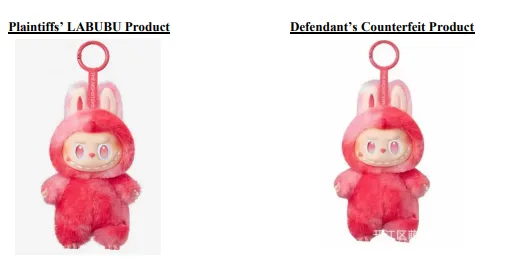
Pop‑Mart’s lawsuits target Chinese sellers active on international e‑commerce platforms. These sellers are alleged to have sold unauthorized keychains, plush toys and other merchandise featuring LABUBU designs, in violation of trademark rights, copyrights, and against false designation of origin, among other claims. Notably, Pop‑Mart has sought extremely substantial damages: up to USD 2 million per counterfeit mark; up to USD 150 000 for each copyright‑infringing work. Additional treble damages, punitive damages and attorney’s fees may also be awarded. Meanwhile, Pop‑Mart has moved for a full asset freeze against defendants, the destruction of infringing products and packaging, and an order compelling disclosure of complete sales books and profit breakdowns. The complaint side‑by‑side exhibits genuine Pop‑Mart goods versus counterfeit items.
II. Cross‑border E‑commerce: a High‑risk Zone for IP Infringement
This case lays bare a harsh reality: cross‑border e‑commerce has become a high‑incidence arena for intellectual‑property infringements. Many sellers assume that the “manufacture‑at‑home, sell‑overseas” model insulates them from IP risks. In fact, IP protection is enforced far more rigorously in Europe and the United States than in China. Upon a finding of wilful infringement, sellers face not only massive damage awards, but also store shutdowns by platforms, frozen payment accounts, and even placement on international trade blacklists.
III. Infringement Risks Are Not Limited to Intentional Counterfeiting
It is worth noting that IP liability does not arise only from deliberate counterfeiting. Many sellers may get entangled in infringement lawsuits unwittingly due to careless product sourcing or inadequate IP searches. For instance, in Bulgari, S.P.A. v. Xiaohong, the defendant argued: “I grew up in a remote rural area with no familiarity with European luxury goods or brand names, including Bvlgari.” Nevertheless, the court ruled against the defendant.
IV. Compliance Advice: How Cross‑border E‑commerce Sellers Can Mitigate IP Risks
Conduct IP due diligence prior to product selection
Before listing any product, search relevant trademark, patent and copyright databases of target jurisdictions (such as USPTO and EUIPO) to verify that the goods do not violate third‑party intellectual‑property rights.
Build an in‑house IP portfolio
For self‑designed or branded products, file trademark and design patent applications in key markets including the United States and the European Union at an early stage, building a defensive IP moat.
Exercise caution in supply‑chain management
Clarify IP rights and obligations with suppliers, demand proof of IP authorization, and include contractual clauses allocating liability for infringement.
Conduct regular infringement‑risk monitoring
Deploy brand‑monitoring tools to regularly scan platforms for infringing goods, and identify and remove high‑risk listings in a timely manner.
Get familiar with platform IP protection rules
Major e‑commerce platforms have established IP‑protection mechanisms (such as Alibaba’s anti‑counterfeiting system). Sellers should proactively register for and leverage these tools to safeguard their legitimate interests.
V. Conclusion
Pop‑Mart’s large‑scale litigation marks a milestone for Chinese‑brand intellectual‑property protection abroad, while delivering a stark wake‑up call to the cross‑border e‑commerce sector. As global IP enforcement grows increasingly stringent, the era of extensive‑mode operations for cross‑border sellers is drawing to an end. Only by prioritizing compliance and implementing a robust IP risk‑control system can Chinese sellers achieve sustained success in international markets and truly evolve from “Chinese sellers” into “global brands”.